Wyevale Nurseries
Agapanthus (African Lily) 'Ever Sapphire'
Couldn't load pickup availability
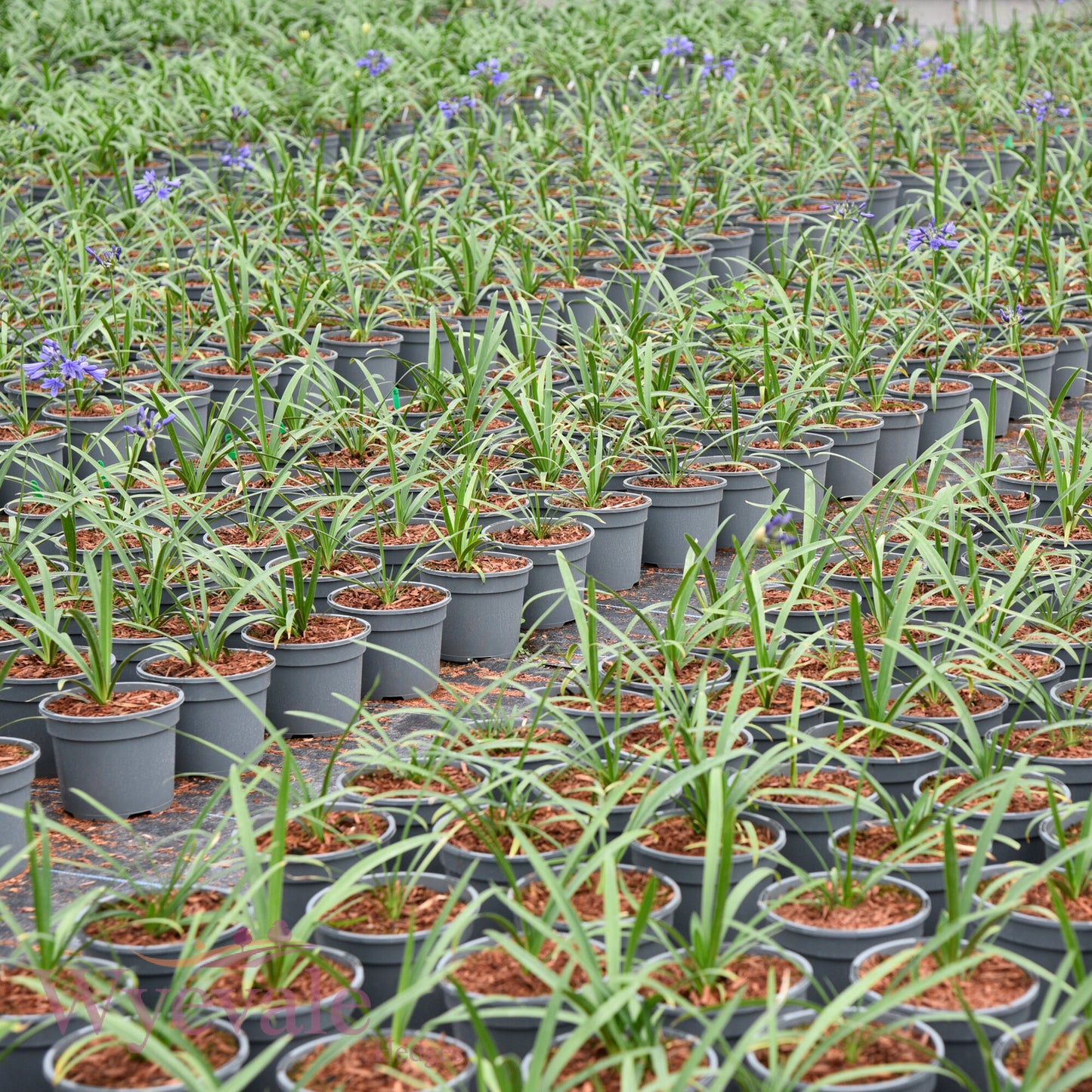
Distinguished by its deep sapphire blue flower clusters, this elegant agapanthus makes a bold statement in summer borders and patio containers. The rich colour of its spherical blooms appears more intense than many other blue flowering types, creating a striking contrast against the slender arching green leaves. Well suited to British gardens, it performs reliably in sunny spots with good drainage and shows good resistance to wind exposure. The strong stems hold their shape beautifully, making these flowers excellent for cutting while maintaining their ornamental appeal in the garden for weeks. A superb choice for adding vertical interest to coastal gardens or contemporary planting schemes.
Share

Agapanthus (African Lily) 'Ever Sapphire'
Distinguished by its deep sapphire blue flower clusters, this elegant agapanthus makes a bold statement in summer borders and patio containers. The rich colour of its spherical blooms appears more intense than many other blue flowering types, creating a striking contrast against the slender arching green leaves. Well suited to British gardens, it performs reliably in sunny spots with good drainage and shows good resistance to wind exposure. The strong stems hold their shape beautifully, making these flowers excellent for cutting while maintaining their ornamental appeal in the garden for weeks. A superb choice for adding vertical interest to coastal gardens or contemporary planting schemes.
Family of Trees: Amaryllidaceae
Habit: Perennial, Clump-forming
Growth Rate: 30-60 cm/year
Optimal Temperature: 15-25°C, hardy to -10°C
Harmful if Eaten?: Toxic if ingested
Flowers or Berries: Deep Blue Flowers
Hardiness ratings
All ratings refer to the UK growing conditions unless otherwise stated. Minimum temperature ranges (in degrees C) are shown in brackets
- ○ H1a: under glass all year (>15C)
- ○ H1b: can be grown outside in the summer (10 - 15)
- ○ H1c: can be grown outside in the summer (5 - 10)
- ○ H2: tolerant of low temperatures, but not surviving being frozen (1 to 5)
- ○ H3: hardy in coastal and relatively mild parts of the UK (-5 to 1)
- ○ H4: hardy through most of the UK (-10 to -5)
- ○ H5: hardy in most places throughout the UK even in severe winters (-15 to -10)
- ○ H6: hardy in all of UK and northern Europe (-20 to -15)
- ○ H7: hardy in the severest European continental climates (< -20)
Features
Soil Types
| Spring | Summer | Autumn | Winter | |
|---|---|---|---|---|
| Leaves | ||||
| Flowers | ||||
| Berries |
Sandy
Clay
Loamy
Moisture:
Drought Tolerant
PH Levels:
10
4
5
8
Spring
Summer
Autumn
Winter
Bareroot Discount
Container Discount
Canes / Guards Discount
Site Discount
VAT Included
Container Minimum Spend
Free Delivery
Quantity
Ever Sapphire 2L
Spacing:
5Only 85 left!
Price: £0.00 £0.00
Total: £0.00
More Information:

You May Also Like:
Acer campestre (Field maple)
Matching Tags: Pollinator
Habit: Tree, Suitable for Hedging
Growth Rate: 30 to 60 cm/year
Alstroemeria (Peruvian Lily) 'Inticancha Paraiso'
Matching Tags: Flowers, Pollinator
Habit: Herbaceous Perennial
Growth Rate: Fast
Alstroemeria (Peruvian Lily) 'Inticancha Sunset'
Matching Tags: Flowers, Pollinator
Habit: Herbaceous Perennial
Growth Rate: Fast
Amelanchier canadensis (Snowy Mespilus) 'Rainbow Pillar'
Matching Tags: Flowers, Pollinator
Habit: Columnar Tree
Growth Rate: 30-60 cm/year
Anemone (Windflower) 'Wild Swan'
Matching Tags: Flowers, Pollinator
Habit: Compact Perennial
Growth Rate: Moderate
Bareroot Acer campestre (Field Maple)
Matching Tags: Pollinator
Habit: Tree
Growth Rate: 30 to 60 cm/year
Bareroot Acer pseudoplatanus (Sycamore)
Matching Tags: Pollinator
Habit: Deciduous Tree, Broad Crown
Growth Rate: 40-80 cm/year
Bareroot Alnus cordata (Italian Alder)
Matching Tags: Pollinator
Habit: Deciduous tree
Growth Rate: 60 to 90 cm/year (fast)
Bareroot Alnus glutinosa (Common Alder)
Matching Tags: Pollinator
Habit: Deciduous tree
Growth Rate: 40 to 60 cm/year
Bareroot Betula pendula (Silver Birch)
Matching Tags: Pollinator
Habit: Deciduous Tree
Growth Rate: 45-60 cm/year
Bareroot Carpinus betulus (Hornbeam)
Matching Tags: Pollinator
Habit: Deciduous Tree, Suitable for Hedging
Growth Rate: 30-60 cm/year
Bareroot Castanea sativa (Sweet Chestnut)
Matching Tags: Pollinator
Habit: Deciduous Tree
Growth Rate: 30-60 cm/year
Bareroot Cornus alba (Siberian Dogwood) 'Sibirica'
Matching Tags: Flowers
Habit: Deciduous Shrub
Growth Rate: 40-60 cm/year
Bareroot Cornus alba Sibirica (Red-barked Dogwood)
Matching Tags: Pollinator
Habit: Deciduous shrub, Suitable for Hedging
Growth Rate: 45-60 cm/year
Bareroot Cornus sanguinea (Common Dogwood)
Matching Tags: Flowers
Habit: Deciduous Shrub, Suitable for Hedging
Growth Rate: 40-60 cm/year
Bareroot Cornus sericea (Golden-Twig Dogwood) 'Flaviramea'
Matching Tags: Flowers, Pollinator
Habit: Deciduous Shrub
Growth Rate: Fast
Bareroot Corylus avellana (Hazel)
Matching Tags: Pollinator
Habit: Deciduous Shrub/Tree
Growth Rate: 30-60 cm/year
Bareroot Crataegus monogyna (Hawthorn)
Matching Tags: Flowers, Pollinator
Habit: Deciduous Tree/Shrub, Suitable for Hedging
Growth Rate: 30-60 cm/year
Bareroot Euonymus europaeus (Spindle)
Matching Tags: Flowers
Habit: Deciduous Shrub/Tree, Suitable for Hedging
Growth Rate: 20-40 cm/year
Bareroot Ligustrum ovalifolium (Californian Privet)
Matching Tags: Flowers
Habit: Semi-deciduous Shrub, Suitable for Hedging
Growth Rate: Fast
Bareroot Ligustrum ovalifolium (Golden Privet) 'Aureum'
Matching Tags: Pollinator
Habit: Evergreen Shrub, Suitable for Hedging
Growth Rate: 30 to 60 cm/year
Bareroot Ligustrum vulgare (Wild Privet)
Matching Tags: Flowers
Habit: Semi-evergreen Shrub, Suitable for Hedging
Growth Rate: Moderate to Fast
Bareroot Lonicera nitida (Box Honeysuckle)
Matching Tags: Pollinator
Habit: Evergreen Shrub, Suitable for Hedging
Growth Rate: 30-50 cm/year
Bareroot Malus sylvestris (Crab Apple)
Matching Tags: Flowers, Pollinator
Habit: Deciduous Tree
Growth Rate: 30-60 cm/year
Bareroot Native Wildlife Mix
Matching Tags: Flowers
Habit: Suitable for Hedging
Bareroot Prunus avium (Wild Cherry)
Matching Tags: Flowers, Pollinator
Habit: Deciduous Tree, Upright Spreading
Growth Rate: Fast
Bareroot Prunus padus (Bird Cherry)
Matching Tags: Flowers, Pollinator
Habit: Deciduous Tree
Growth Rate: 30-60 cm/year
Bareroot Prunus spinosa (Blackthorn)
Matching Tags: Flowers, Pollinator
Habit: Deciduous Shrub, Suitable for Hedging
Growth Rate: 20-40 cm/year
Bareroot Pyrus communis (Pear)
Matching Tags: Pollinator
Habit: Deciduous Tree, Upright Spreading
Growth Rate: 30-60 cm/year
Bareroot Quercus palustris (Pin Oak)
Matching Tags: Pollinator
Habit: Deciduous Tree, Pyramidal when young
Growth Rate: 45-60 cm/year
Bareroot Quercus petraea (Sessile Oak)
Matching Tags: Pollinator
Habit: Deciduous Tree, Broad Crown
Growth Rate: 30-50 cm/year
Benefits of Transplanting
- Bushier Appearance: Trimming roots and tops encourages new branch growth, making plants fuller and more attractive.
- Stronger Immune System: Promotes fibrous lateral roots, improving nutrient and water uptake, resilience, and disease resistance.
- Improved performance: Denser foliage protects against wind, sun, and noise, while providing safer shelter and more food for wildlife.
Benefits of Undercutting
- Bushier Appearance:
Trimming roots during transplanting stimulates new branch growth, making the plant fuller and more attractive. - Stronger Immune System: Encourages fibrous lateral roots, boosting nutrient and water uptake, resilience, and disease resistance.
- Improved performance: Denser foliage protects against wind, sun, and noise, while offering better shelter and food for wildlife.
Cuttings to Hedges
- Genetic copies: Cuttings come from mature parent plants, ensuring identical, high-quality plants.
- Carefully rooted: Skilled horticulturists incubate cuttings under controlled conditions for strong, successful root growth.
- Nature hardened: Plants are grown outdoors, exposed to the elements, developing resilience and robustness before reaching you.
Lets Examine These Hawthorn
- Side branches: The 2 year transplant is growing into a hedge structure
- Thicker stem: The stem is about 3 times thicker and much more sturdy
- Bigger roots: The root mass is much higher on the 2 year transplant
Same Height Different Shape
- Wyevale Transplants have stronger structures
- Healthy branching for hedge formation
- Stronger root systems for higher survival rates
- Choosing a selection results in a full page refresh.
- Opens in a new window.